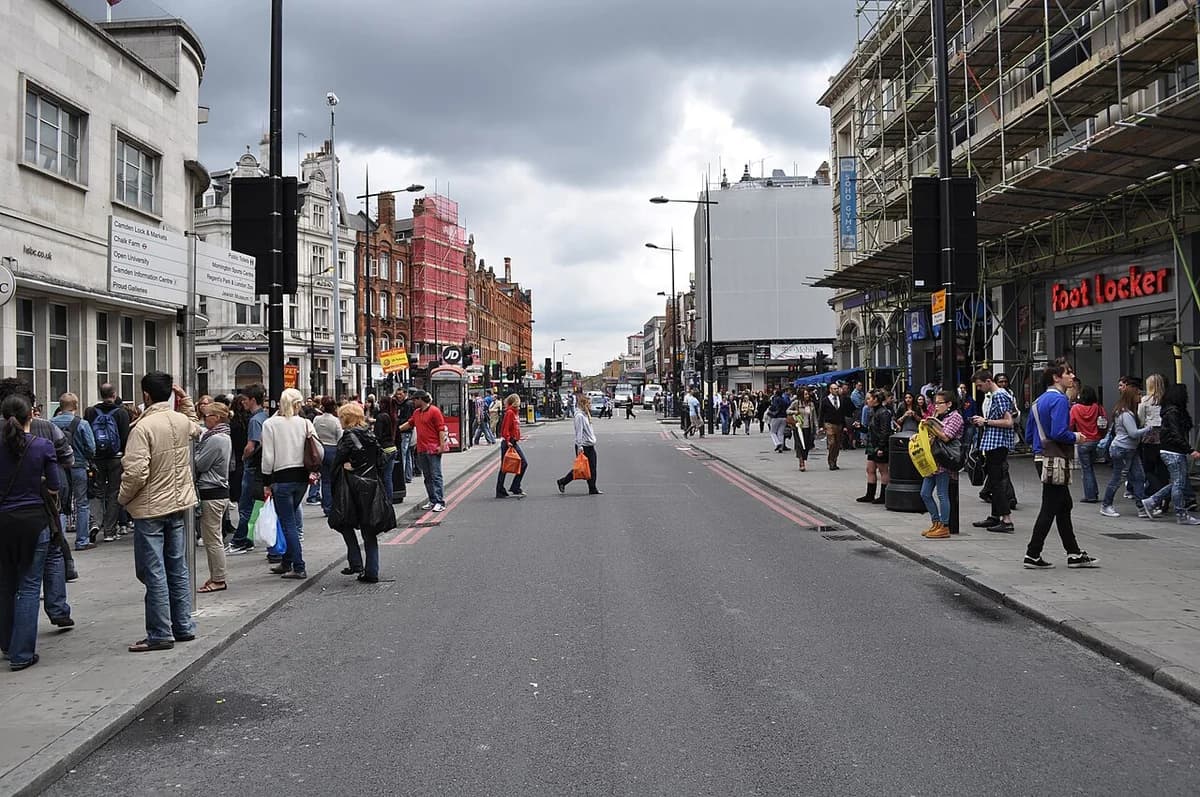
Camden High Street will remain a permanent 24/7 car-free zone after Camden Council confirmed on Tuesday (October 27) that an 18-month trial has delivered “positive outcomes”. The changes take effect at the end of October 2026, following a second consultation that showed 57 per cent of respondents support making the restrictions permanent.
The pedestrianisation scheme launched in May 2025 with £5m in funding from Transport for London. During the trial period, traffic collisions on Camden High Street dropped to zero, compared with 6 collisions and 8 casualties in the previous year. The council also reported a 14.4 per cent reduction in nitrogen dioxide (NO₂) concentration levels across monitored sites within the zone.
However, support for the permanent ban is divided. While 57 per cent of all respondents backed the move in the follow-up consultation, only 51 per cent of those living within the vicinity were in favour – and 43 per cent of residents and businesses either strongly disagreed or actively opposed a permanent ban. However, support was significantly higher among those living outside the zone, with 87 per cent of respondents from outside Camden backing the permanent ban. Retailers raised concerns about obscured shop fronts and difficulties loading and unloading goods.
Mixed air quality improvements
The air quality gains are more modest than headline figures suggest. While NO₂ fell 14.4 per cent on Camden High Street itself, comparison sites outside the zone also saw a 12.6 per cent drop during the same period. This means the net improvement attributable to the pedestrianisation is roughly 1.8 per cent. On nearby Kentish Town Road, where traffic was diverted, NO₂ concentration actually rose by 1.5 per cent – though the council says levels remain within national legal limits.
Traffic has increased on surrounding routes including Hawley Crescent, Delancey Street and Gloucester Avenue. Bus services have also been affected, with diversion through alternative roads adding 90 seconds to average journey times. The council acknowledged these concerns and has begun installing a new northbound bus lane and acknowledged concerns about bus delays caused by the high street traffic ban on Kentish Town Road, approved in 2024 but postponed by the trial. This is set to launch in autumn 2026.
Emergency service vehicles, council refuse vehicles and northbound cyclists will remain exempt from the permanent ban. Motor vehicles requiring access for essential maintenance or transporting bulky goods can also travel through with prior approval. The zone extends between Britannia Junction and the junction connecting Jamestown Road and Hawley Crescent.
Safety and community concerns
Officers cited police data which appeared to show anti-social behaviour, pickpocketing and other offences fell after the street became pedestrian-only. But residents raised ongoing concerns over anti-social behaviour, night-time safety and conflicts between pedestrians and e-bike users. The council has committed to stepping up community safety patrols following resident feedback. Cllr Slater said the high street would also undergo a deep clean following resident feedback.
Council planning chief Cllr James Slater said the scheme had improved air quality and tackled pedestrian “overspilling” onto pavements. “Camden Town is an internationally recognised destination that draws people in from across London, the rest of the UK and the world,” he said. Slater is set to become Council Leader in November. The council estimates administering the permanent ban will cost £10,000 annually.
Further pedestrianisation planned
Camden Council has also proposed expanding the pedestrianised zone towards Camden Lock and Chalk Farm. A formal consultation on designs for this expansion is set to launch in spring 2027. Plans to plant new street trees, planters and seating on Camden High Street are in development, though the council has not yet secured funding for these improvements.
The first consultation on the trial scheme, held in summer 2024, showed 71 per cent of respondents supported the experiment. During the feedback phase on the permanent ban, residents expressed concerns that drivers may speed or breach restrictions to avoid congestion, and that vehicle restrictions could simply displace traffic onto adjacent roads, creating new bottlenecks and pushing pollution elsewhere.